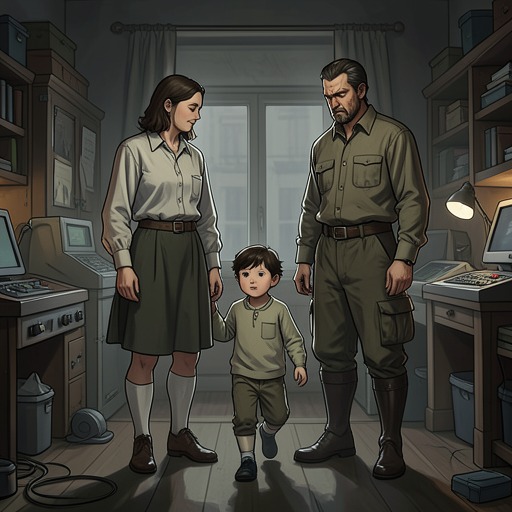
Ben and Cillian Boyd: partners raising Todd together
The Knife of Never Letting GoBen and Cillian Boyd are friends turned partners in raising Todd Hewitt: two men who joined the same New World settlement and took in a boy orphaned by the violence that followed. Their bond is expressed less through declarations than through a shared household, different styles of care, and a final decision made together to protect Todd. When danger closes in, their partnership becomes a division of risk: Ben leads Todd away, while Cillian stays behind.## Origins and shared life Before Todd’s birth, Ben and Cillian Boyd were already connected through the Church and the decision to leave for New World. In the family history Todd hears through Noise, his mother was friends with Ben, and Ben persuaded Cillian to join the settlement; Todd’s mother, in turn, persuaded Todd’s father. Once the settlers arrived, Todd’s parents raised sheep on a farm next to Ben and Cillian’s wheat farm. The remembered picture is one of neighboring households and a communal beginning, though Todd recognizes that the story carried in Noise cannot tell him exactly what life was like before he was born.
The closeness of the farms gives their later role in Todd’s life a practical as well as a familial foundation. After Todd’s mother died and the war devastated the settlement, Ben and Cillian took in the baby. Todd recalls that they fed him, raised him, taught him, and made it possible for him to survive. Their partnership thus becomes a parenthood formed by circumstance and sustained by daily responsibility: they share the work of bringing up a child who is not biologically theirs, in a community where many children have been left without adequate care.
Todd’s own description of his place in their family holds affection and uncertainty together. He thinks of himself as their son, but hesitates to call himself fully their child. He never knew his father, and imagines that if he could choose a father, Ben would be a good choice. That comparison does not erase Cillian’s role; it reveals that Todd experiences the two men differently, even as both have raised him.## Two styles of care In Todd’s view, Ben is unusually kind for a man of Prentisstown. The distinction matters in a town where Todd expects most men to ignore or hurt him, and where finding ways to avoid attention is part of his daily survival. Ben’s care is therefore not merely a private comfort: it sets him apart from the surrounding culture and gives Todd a person he can trust.
Cillian’s care is harder for Todd to recognize. He argues with Todd frequently, and Ben explains that Cillian does so because he cares deeply. Todd doubts that this is a convincing way to show affection. The tension between Ben’s gentleness and Cillian’s severity shapes the family’s emotional texture: care is present, but it does not always arrive in a form Todd can readily interpret. Todd’s account does not resolve that disagreement by declaring Cillian’s manner harmless; it preserves the gap between Ben’s explanation and Todd’s lived experience.
Todd also registers the men as distinct in the way their Noise seems to him. Ben’s is calmer and clearer, which Todd associates with blue or green, while Cillian’s seems reddish. The contrast gives sensory form to the difference Todd already perceives in their temperaments. They are not interchangeable guardians. Their shared responsibility holds together two different ways of being present to him, and Todd’s dependence on both coexists with his greater ease in describing Ben’s tenderness.## A decision made together When the danger surrounding Todd becomes immediate, Ben and Cillian respond in concert. Ben understands that Todd must leave and urgently warns him to conceal his thoughts in his Noise. Cillian arrives, and Ben cuts off the possibility that he might think openly about what is happening. Their fear is apparent to Todd, even before he understands why they are acting so quickly. Cillian then confirms that they will have to do it now, and Ben agrees. The exchange is brief, but it shows that the plan belongs to both of them: they share the knowledge and the decision, while trying to keep Todd from exposing it.
After Mr Prentiss Jr leaves, Cillian says Todd has to go back through the swamp. Ben had hoped for another outcome, and Cillian shares that hope, but neither lets it prevent the necessary choice. Their sorrow is not evidence of disagreement about whether to protect Todd; it is the cost of accepting that protection requires separation. Cillian says Todd may hate them, asking him to believe the decision comes from love. Todd rejects the reassurance, unable to experience a loving decision as all right when it means being sent away.
The partners then divide the danger between them. Cillian stays to hold off those pursuing Todd for as long as he can; Ben intends to take a different route afterward and try to mislead the pursuers. Before Ben leads Todd out through the back door, the two men clasp hands for a long moment. The gesture makes visible what the conversation has held beneath its practical instructions: they are not simply coordinating an escape, but parting as partners who know the separation may be final. Todd sees Cillian look toward him, understands that Cillian does not expect to see him again, and loses the chance to speak when the door closes. Ben accompanies Todd toward the river and the swamp; Cillian remains behind. The account establishes this as a grave farewell, without stating what later becomes of Cillian.## Care within a violent society The history Ben later recounts to Todd and Viola widens the meaning of the household Ben and Cillian built. New World’s hardships included failing crops, sickness, and a lack of prosperity. Blame spread from those troubles into a movement against the Spackle and then into war. Ben describes the unequal forces: humans had guns, while the Spackle did not, and the war ended in their defeat. Todd acknowledges that not all the Spackle were killed, but that the survivors learned to avoid coming near men. This history places the partners’ shared care in a society already organized by fear, prejudice, and violence.
The later revelation that Prentisstown’s men killed women, including Todd’s mother, makes the conditions of Todd’s upbringing still more painful. Ben confirms that many men, influenced by Mayor Prentiss and Aaron’s preaching, killed women and men who tried to protect them. The evidence does not identify Ben or Cillian as participants in those killings, and their role in Todd’s life is established as that of the men who took him in and raised him. Their partnership is consequently important not as proof that they escaped the society around them, but as the means by which an orphaned child received care in its aftermath.
Todd’s later understanding of Prentisstown’s coming-of-age killings adds another dimension to the danger against which they acted. Men who had supposedly disappeared had in fact been killed, sometimes by boys made to carry out the act on their thirteenth birthdays; even a man who tried to flee through the swamp was executed under the law. Todd concludes that the town’s people were complicit and guilty, while he was not. Against this account of a community that makes violence part of adulthood, Ben and Cillian’s decision to raise Todd and then send him beyond its reach stands as an act of protection. Their shared care does not undo the town’s crimes, but it gives Todd a family tie and a chance to leave rather than be absorbed into its system.
Separation and significance
The relationship’s decisive change is not a falling-out but a forced division of labor. Ben goes with Todd; Cillian stays to delay the danger. The long clasp of hands and Cillian’s final look bind that practical split to the history of their household, while the closed door makes the separation irreversible within the scene. For Todd, the moment clarifies both the depth and the limits of his place in their family: the men have raised him together, yet protecting him now means that one of them must remain behind.
Their relationship is therefore central to the distinction between biological parenthood and chosen responsibility in Todd’s early life. Ben’s kindness gives Todd a model of care he can name, while Cillian’s frequent arguments leave that care harder for him to read. Neither difference cancels their shared work as parents. Their partnership is shown through the years of raising Todd, their synchronized response to the threat, and their readiness to separate in order to give him a chance to escape. The farewell does not offer reunion or resolution; it leaves the bond present in the very act of parting.